
Opening a Dialog
view codeOpening a static Dialog
The layout of the Dialog is fully described by the referenced HTML template: either the default "#dialog_generic" of a specific one.
You can fully customize the rendering with CSS; the default styles are provided by static/frontend_forms/css/frontend_forms.css
dialog1 = new Dialog({
    dialog_selector: '#dialog_generic',
    html: '<h1>Static content goes here ...</h1>',
    width: '600px',
    min_height: '200px',
    title: '<i class="fa fa-calculator"></i> Select an object ...',
    footer_text: 'testing dialog ...',
    enable_trace: true
});

dialog1.open()
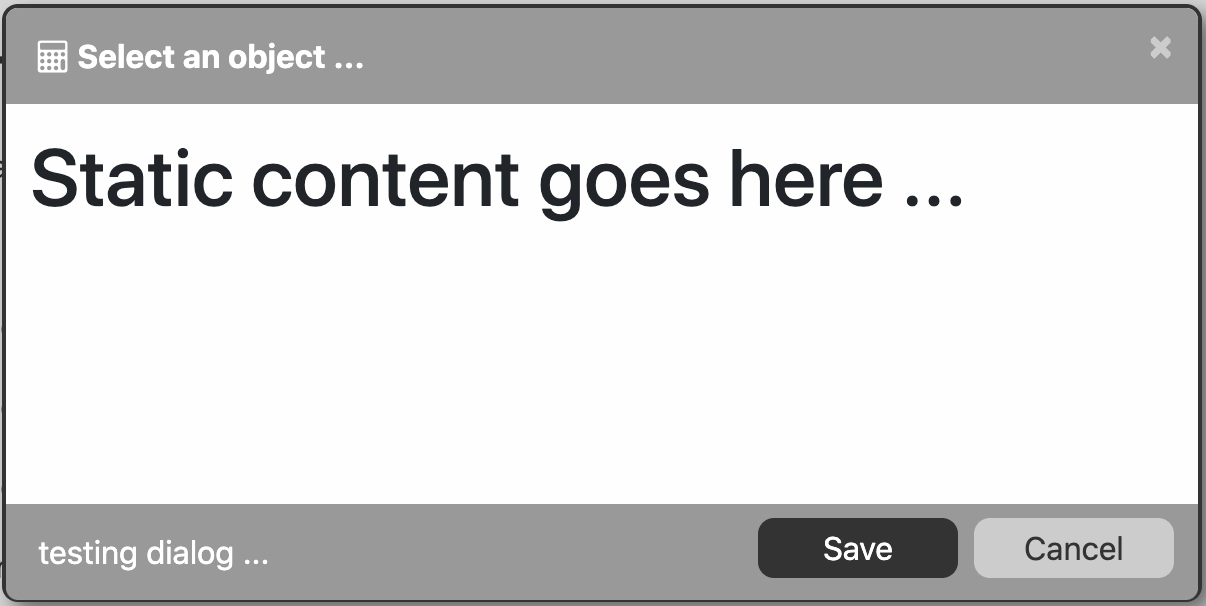
A simple static Dialog
Opening a dynamic Dialog
In most cases, you will rather produce the dialog content dynamically.
To obtain that, just add an "url" option to the Djalog constructor, and it will be automatically used to obtain the Dialog content from the server via an Ajax call.
dialog1 = new Dialog({
    ...
    url: "/samples/simple-content",
    ...
Sometimes it is convenient to reuse the very same single view to render either a modal dialog, or a standalone HTML page.
This can be easily accomplished providing:
- an "inner" template which renders the content
- an "outer" container template which renders the full page, then includes the "inner" template
- in the view, detect the call context and render one or another
def simple_content2(request):

    # Either render only the modal content, or a full standalone page
    if request.is_ajax():
        template_name = 'frontend/includes/simple_content2_inner.html'
    else:
        template_name = 'frontend/includes/simple_content2.html'

    return render(request, template_name, {
    })
here, the "inner" template provides the content:
<div class="row">
    <div class="col-sm-4">
        <p>Saepe quibusdam qui culpa consequuntur dolorem, nesciunt aut tempore ratione officiis enim ex nisi, dolore quo veniam excepturi adipisci aperiam earum nostrum. Aperiam quod ab repudiandae repellendus nulla quaerat expedita reiciendis facere, libero alias in iste?</p>
    </div>
    <div class="col-sm-4">
        <p>Temporibus totam dolores molestias eos suscipit ab, nam dicta incidunt, eos quam ab obcaecati perferendis adipisci suscipit sit odio debitis, amet nihil sint similique odit. Nesciunt odio dolor tempore porro asperiores assumenda numquam vero ab suscipit veritatis, consequuntur praesentium mollitia ducimus eveniet laudantium sunt? Illo possimus explicabo ea quam, dolor eum dolorum incidunt, pariatur obcaecati reprehenderit accusantium veritatis, sapiente aut velit doloribus, ipsam error architecto temporibus ipsum reiciendis veniam? Blanditiis et rem error, sapiente consequuntur accusantium nam beatae laborum eum in dolorem culpa soluta, amet vitae repudiandae maiores ducimus quasi facilis, alias maxime saepe incidunt quis delectus ratione porro reiciendis nulla dolore, excepturi in cumque?</p>
    </div>
    <div class="col-sm-4">
        <p>Quas praesentium accusantium debitis?</p>
    </div>
</div>
while the "outer" one renders the full page:
{% extends "base.html" %}
{% load static staticfiles i18n %}

{% block content %}
{% include 'frontend/includes/simple_content2_inner.html' %}
{% endblock content %}